

• Heard of Growth Mindset in education or at work?
• Do you have a FIXED or GROWTH mindset on your biggest challenge?
• Know these two small words – YET & GET – can transform the way you perceive a problem?
Here, red10 ‘s Lisa Smith gives a red10 intro to Carol Dweck’s Growth Mindset principles, and how crucial they are in shaping your success, adaptability and outcomes.
Growth Vs Fixed Mindset
In today’s rapidly evolving business landscape, the mindset of managers and employees plays a crucial role in shaping the success and adaptability of a global corporation.
There are two contrasting mindsets:

Our choice of mindset will significantly impact how we approach challenges, innovate, and lead.
Growth mindset, an idea developed by psychologist Dr Carol Dweck at Stanford University, refers to the belief that abilities and intelligence can be developed through dedication and hard work.
People with this mindset embrace challenges, learn from criticism, and persist in the face of setbacks, fostering a culture of continuous improvement and resilience.
On the other hand, a fixed mindset is characterised by the belief that abilities and intelligence are static traits that cannot be changed.
Managers with a fixed mindset may avoid challenges, feel threatened by others’ success, and give up easily when faced with difficulties. This can lead to a stagnant organisational culture where fear of failure stifles innovation and limits potential growth.
It is important to note that we are all a mixture of growth and fixed mindset, depending on the circumstances.
You can take this IDR Labs test which highlights an individual’s degree of fixed versus growth mindset based on Dweck’s research:
Growth Mindset Wall
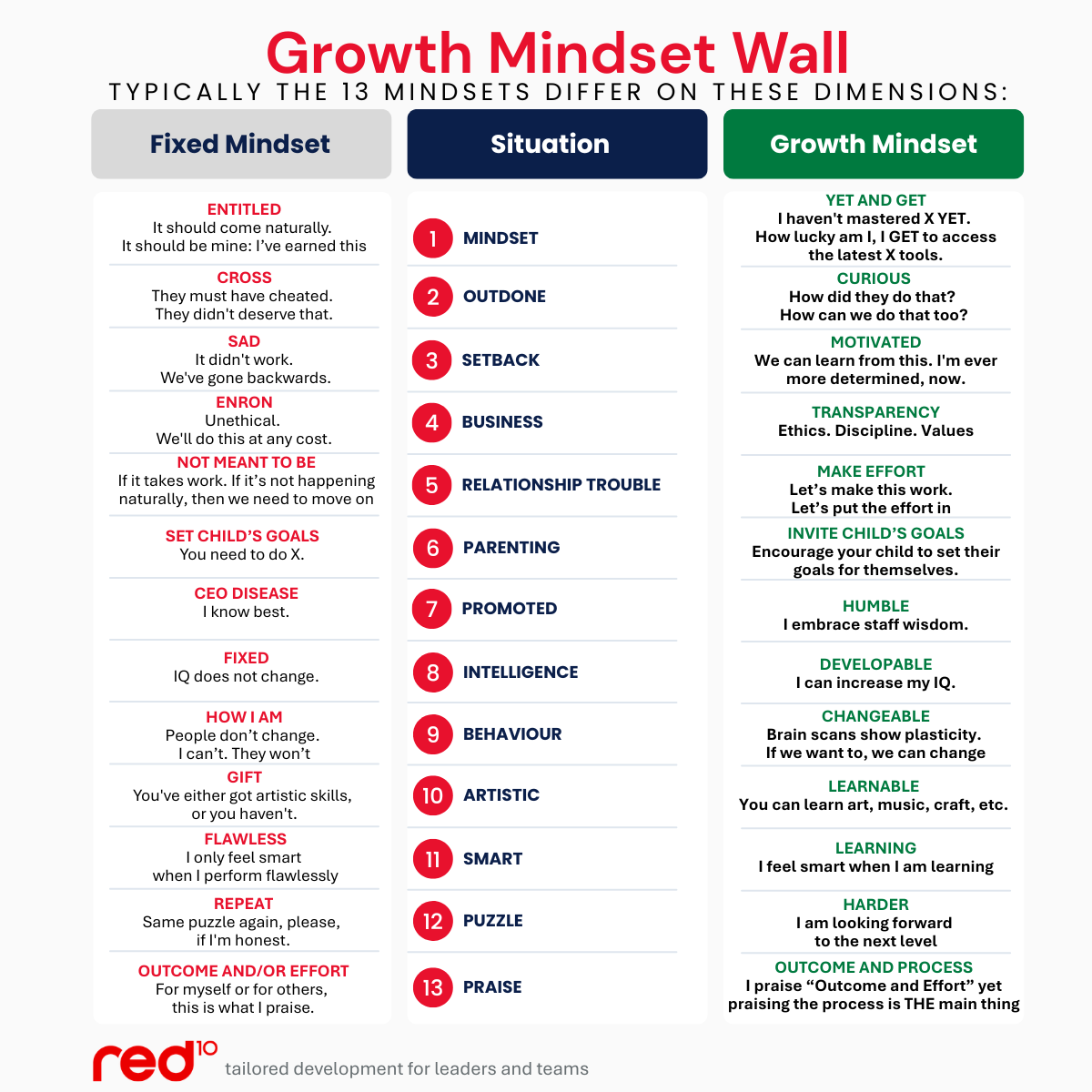
For all of us working in global business, adopting a growth mindset is essential. It not only enhances personal development but also drives team performance, encourages creativity, and supports the company’s ability to navigate complex, dynamic markets.
Three steps to developing a growth mindset
It’s all about noticing your mindset and embracing failure or limitations:
- Hear – Learn to hear your fixed mindset voice, for example: “I can’t possibly travel to Germany three times a year for meetings.” or “I just don’t understand how that part of the business works.”
- Choose – Recognise that you ALWAYs have a choice about your response to obstacles, failure, set-backs and criticism.
- Reframe – Reframe with a growth mindset voice using GET & YET: “I GET to travel to Germany three times a year for meetings.” or “I don’t understand how that part of the business works – YET.”
Try asking yourself “Is this belief I have real, or does it just feel real?” – it will help you develop a growth mindset.
Why do smart leaders get stuck?
One of the most uncomfortable insights in Mindset is that intelligence and early success can actually work against long-term leadership growth. Leaders who have always been “the capable one” may unconsciously avoid situations where they might struggle, fearing it threatens their identity.
Dweck shows how this plays out in organisations: leaders stick to what they know, over-control decisions, or surround themselves with people who won’t challenge them. Performance plateaus, innovation slows, and psychological safety erodes.
For red10, this connects strongly to leadership transitions. Many leaders stall not because they lack skill, but because their mindset hasn’t evolved with their role. The move from “expert” to “leader of experts” requires a shift from proving competence to enabling learning — in themselves and others.
How does mindset shape team culture?
Mindset isn’t just personal — it’s contagious. Leaders signal what matters through what they praise, tolerate, and punish. Do they reward effort and learning, or only outcomes? Do they ask curious questions, or look for blame?
Dweck’s research shows that teams led with a growth mindset are more collaborative, more resilient, and more willing to take intelligent risks. People are likelier to speak up, share ideas, and recover quickly from setbacks.
This aligns closely with red10’s work on conditions-based leadership. When leaders shift their mindset, they don’t need to “motivate” people, they create the conditions where motivation and performance emerge naturally.
What does growth mindset look like in action?
A growth mindset isn’t about being relentlessly positive or pretending failure doesn’t hurt. It’s about how leaders respond when things go wrong.
Growth-minded leaders:
- Seek feedback, even when it’s uncomfortable
- Separate identity from performance
- Model learning publicly
- Reframe mistakes as experiments, not verdicts
Importantly, they also avoid the trap of “false growth mindset” — praising effort without learning, or using the language of growth without changing behaviour. Dweck is clear: mindset is revealed through action, not slogans.
Can mindset really be changed?
One of the most hopeful messages in Mindset is that mindsets themselves are malleable. Leaders don’t need to label themselves as fixed or growth — they can learn to notice fixed-mindset triggers and deliberately respond differently.
For leaders, this often starts with self-awareness:
- When do I become defensive?
- Where do I avoid challenge?
- How do I react when someone fails?
From there, small behavioural shifts — asking better questions, inviting dissent, reflecting after setbacks — begin to compound. Over time, mindset becomes culture.
Interested in diving deeper?
Only got 5-mins?
Listen to the Harvard Business Review IdeaCast episode exploring inner conflict and self-leadership:
Got 1 hour or prefer video?
Sounds True / Insights at the Edge full-length interview
Read/listen to the book:
Mindset – Changing the Way You Think to Fulfil Your Potential
• UK Amazon:
https://amzn.eu/d/079iCf3
• USA Amazon:
https://www.amazon.com/Mindset-Psychology-Carol-S-Dweck/dp/0345472322
Have you explored Growth Mindset YET? It is one of red10’s Mini Masterclasses. Your team could GET this training. (See what we did there?)