

Noticed managers and trainers talking more about resilience since the pandemic?
Are you a resilient person?
Know someone whose resilience is impressive, wishing you could be more like them?
Here red10 ‘s Lisa Smith describes what resilience is and offers some tips to increase the ability to bounce back when things get tough.
Those with good resilience bounce back more quickly
When faced with a difficulty, health concern, relationship or work problem resilience is how well a person or team can adapt to the events.
Those with good resilience bounce back more quickly and with less stress than those whose resilience is less developed. They are the bendy rulers, not crackers! They can flex with the circumstances and don’t easily break.
Luckily, we can develop our resilience by applying some foundational principles and habits.
Personal resilience can be hard to maintain, especially when life and work events are challenging. There is no one thing which can make you resilient, but there are many good habits which develop our ability to create and maintain it.
Managing Physical Energy
Movement, good food and sleep are the essential foundations of resilience; however, they are long term investments not short-term wins.
Nutrition
A simple and achievable food hack is to aim to eat 30++ different plant-based foods each week. If you eat an apple every day it scores as 1 – the idea being that you eat a wide variety of plants to enhance gut health which is now being linked to multiple chronic illnesses.
Also consider hydration – drink lots of water and check your caffeine and alcohol consumption.
Movement
Move as many parts of your body, as often as possible, in as many ways as possible. Think about getting a ‘sit-stand’ desk at work and take movement snacks throughout the day. Get outside as much as you can.
Sleep
Sleep is crucial to resilience, so it’s good to know poor patterns habits can be improved:
- Try to go to bed and get up at the same time each day (10pm-6am is optimal)
- Establish a relaxing bedtime routine – have a bath, read a book
- No screens in the bedroom
- Reduce alcohol and caffeine
- Have a cooler bedroom
Dr Matthew Walker’s book Why we Sleep explores the new science of sleep and dreams, watch his TED talk here: Sleep is Your Superpower.
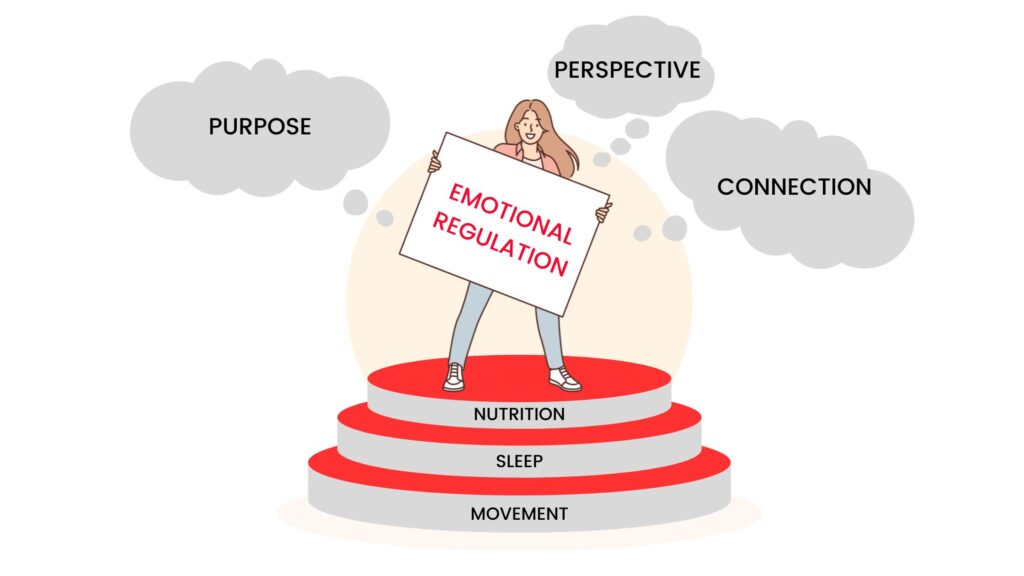
Perspective – mindset and self-talk
When resilience is low, we talk to ourselves in negative ways. We tell ourselves things aren’t possible, that we are not good enough and that a situation is too hard or impossible. This can become a self-fulfilling prophecy.
Try to use language which is positive and reinforces the likelihood of success.
Leaders exhibiting resilience can take a step back from a challenging situation and accept its negative aspects while finding opportunity and meaning amid adversity. They fail forwards.
The act of gaining perspective allows resilient people to focus their efforts on those things they can change and accept those things they cannot.
Connection
Talking about issues and challenges is an essential way to stay upbeat – telling friends and colleagues can normalise problems. Seek opportunities to celebrate successes (your own and other people’s) to help maintain morale.
Offer support where you can, it releases feel-good hormones like dopamine and serotonin. Helping others builds strong social bonds – which in turn build resilience.
Emotional regulation
Being aware of, understanding and regulating our emotions is essential to resilience – not being overtaken by our emotions but allowing time to process them.
Resilient leaders are also aware of the emotions and needs in others and are usually willing to give support.
When you are feeling overwhelmed, take a few deep breaths and try the following 3 steps:
- Feel it – where in your body are you experiencing this?
- Name it – it feels heavy, jittery, wobbly, stuck, hot etc.
- Say it (aloud) – “I am feeling butterflies in my low abdomen.” “My head is spinning.” Or “I have a heavy feeling in my chest.”
Gratitude
It is hard to be angry and grateful; hard to be resentful and grateful. So, focus on what you are grateful for.
Keeping a gratitude journal has been proven to raise morale and improve resilience and motivation.
It is not enough to simply have an attitude of gratitude; you need to do something. For example, each evening, write down 3 – 5 things that you are grateful for from that day. Choose simple things like a coffee with a friend, an unexpected conversation with a stranger or a nice sunset – anything can make the list. It teaches you to notice the good instead of dwelling on the bad.
Here’s an interview with Brené Brown on how gratitude begets joy.
Purpose
Having a clear sense of purpose in our work, a belief that the work that we do is congruent with our personal values and plays to our strengths is vital to resilience at work.
Holding a clear sense of our ‘moral compass’ helps us to keep centred when all around there is change.
Call to action
If you would like to find out more, or arrange resilience training for your team, red10 offers an interactive, research-based Mini Masterclass.
Or you can start your resilience training right now by committing to changing one small thing in your lifestyle or habits – today.