
-
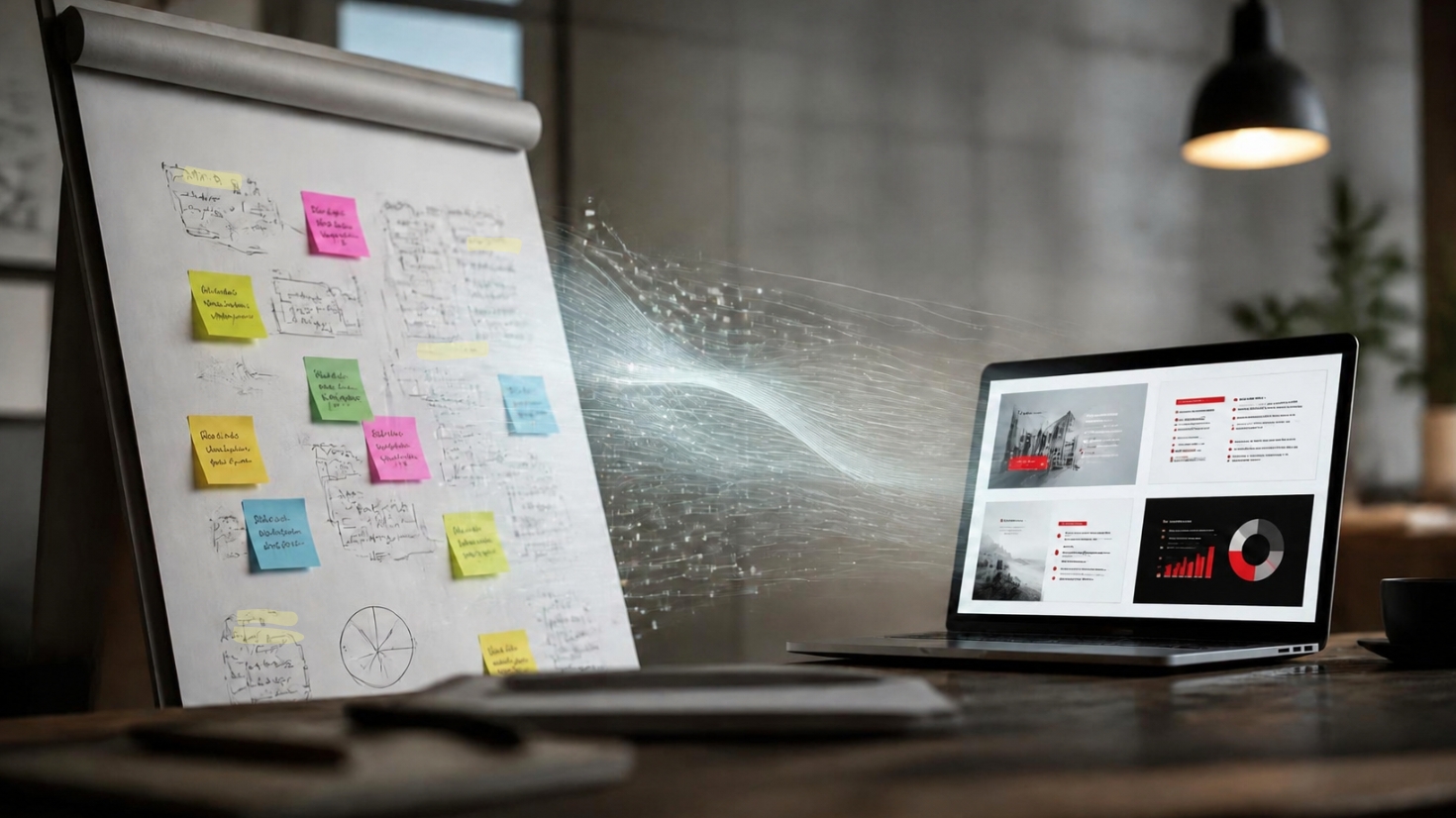
What if the flipcharts typed themselves up?
-
Why does AI do a great job once — and a different job the next time?
-
What changes when the AI can read the handwriting as well as you can?
Here, red10 ‘s Robin Edwards shares the lessons from building Decky; the tool that turns a workshop’s narrative and a phone full of flipchart photos into an editable, client-branded playback deck and why the breakthrough came from not building an app at all.
Why is a playback deck so hard to automate?
After every workshop we send the team a playback deck: the facilitator’s narrative of what happened, with every flipchart, sticky-note wall and whiteboard typed up word for word and laid out on the client’s own template.
No two workshops give you the same ingredients. Different sessions, different walls, different handwriting and a new instruction in every narrative: “show this photo”, “type that up”, “fit all of the above onto one slide”.
Why wasn’t an app the answer?
My first attempt was a desktop app with a guided workflow: load the files, read the text with OCR, check it with AI, build the deck, check the layout.
Each step worked on its own. Together, they kept tripping up:
- Every new kind of input needed new code, so the output drifted from one job to the next
- The same AI prompt gave a great result one day and a different one the next — and OCR simply couldn’t read real handwriting
- Keeping the screens, buttons and progress bars reliable took more effort than the decks themselves
What was the breakthrough?
Stop building an app around the AI, and build the know-how into the AI instead.
“Decky” is now a skill inside Claude: a playbook of our standing rules, a toolkit Claude runs on the PC, and a library of past jobs it copies from. There’s no interface to maintain. You open the job folder and ask for the deck in plain English.
And the models caught up. Today’s models, Opus 5.5 among them, read handwriting, follow a narrative’s instructions to the letter, and work out which flipchart belongs to which presenter’s slide. That’s the kind of understanding OCR never had.
How do you get AI to do a consistent job?
Rules, not prompts.
Every time a reviewer corrects something, it becomes a standing rule that the next job follows. Decky now has more than twenty, including:
- No invented text: titles, labels and captions come from the source, never from the AI
- If a word can’t be read, it’s highlighted yellow and asked about — not guessed
- Nothing below 12pt, and every deck on the client’s own template
- Helpers double-check every deck: one compares each sticky note with the photos, others check the narrative and the layout
Two useful learnings:
- Let the AI say “I don’t know” — a yellow word beats a confident guess.
- Show the source beside the output. Our review page puts each slide next to its photos, so reviewers can check and comment in one click.
Curious what a run looks like? A recent two-day leadership offsite became a 35-slide deck from 38 photos — including a 78-sticky planning map on a single slide — with 13 hard-to-read words flagged for review.
How does it reach the rest of the team?
Decky is now a plugin anyone at red10 can install with a one-click setup. It keeps itself up to date, offers a lean run for smaller plans, and sends what each person teaches it back to me so every job makes the next one better.
Is a skill better than an app?
Not always.
But when the inputs change every time and the judgement matters more than the buttons, a skill wins: the rules are written in plain English, anyone can read them, and improving Decky is a conversation rather than a code release.
It’s also a strong case for spreading vibe-coding beyond a skilled few: the people closest to a process know which rules matter and can now teach them to the AI.
Let’s democratise vibe-coding!
It’s why we’re now providing a 3-hour, up to 10-person practical Vibe-Coding Skills Masterclass built in the same interactive, inclusive style you’re used to from red10.
Which job does your team do again and again …..but never quite the same way twice?
More vibe-coding articles

What actually is vibe coding?
Are you hearing "vibe coding" mentioned more and more? [...]

You don’t have to be a coder
Can you use code without knowing how to write [...]

Vibe coding
Have you “Vibe Coded” with AI, yet? Have you [...]

Thinking in Algorithms
What changes when AI reshapes competition? How can leaders [...]

Helping talent embrace AI
Why aren’t your top performers jumping at the chance [...]
Ask GenAI to Assist
Tried asking GenAI tools like ChatGPT to write for [...]