
-
Who needs attention right now?
-
What’s slipping through the cracks?
-
Could AI see what you’re missing?
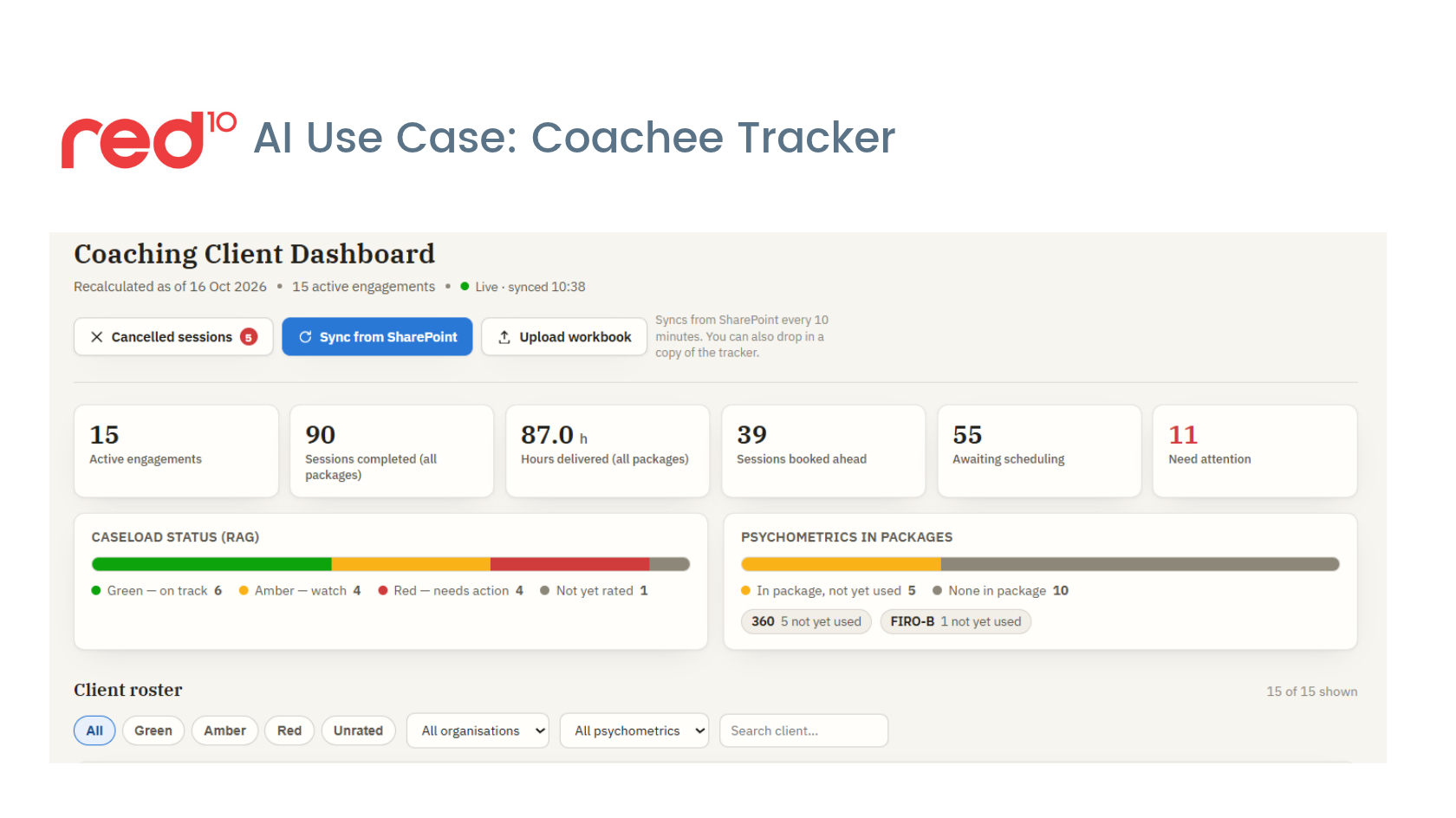
Here, red10 ‘s Karen Hyde shares how she transformed a coaching session-tracking spreadsheet into a live operational dashboard.
Managing multiple coaching clients involves more than keeping a diary. Each client has a package start and end date, an agreed number of sessions, completed appointments, future bookings and actions still to schedule.
The information was all there but it was spread across different rows and multiple worksheets. Answering a simple question such as “Which clients need attention?” required manually checking several places.
The challenge
I wanted one page that would immediately show:
- Every active coaching client
- Package start and end dates
- Sessions remaining or overdue
- Sessions completed and booked
- Sessions still to schedule
- The next appointment
- Clients requiring follow-up
The goal was not another static report. I needed a dashboard that updated automatically as session information changed.
How AI helped
AI helped me turn the operational questions into a practical spreadsheet design.
Rather than beginning with formulas, I began with the decisions the dashboard needed to support:
- Who needs attention now?
- Who does not have enough future sessions booked?
- Which packages are approaching their end date?
- Are clients progressing through their allocated sessions?
- What should I do next?
AI then helped structure the data, connect the client and session records, create formulas and troubleshoot the dashboard logic.
It dramatically shortened the journey from “I know what I need to see” to a working solution.
Creating one reliable view in real time
The finished dashboard brings together three types of information:
1. Client package details, including package dates and contracted sessions
2. Session records, including completed and future appointments
3. Operational notes, providing the context behind each status
The dashboard uses formulas to retrieve package information and calculate progress automatically and shows whether a package is approaching its end date or is already overdue.
An early warning system
A red-amber-green status makes the dashboard easy to scan.
Currently, a client turns amber when they have two or fewer future sessions booked: This provides an early-warning system rather than waiting until appointments run out completely.
That is the difference between just inputting information and actually using it.
AI did not replace human judgement
The most useful part of the dashboard is the combination of calculations alongside human context.
A formula can show that a client has too few sessions booked. It cannot always explain why. There is a status-notes column that records details such as cancellations, holidays or who needs to be rescheduled.
AI helped build the system, but the coaching team still determines what matters, interprets exceptions and decides the appropriate action.
The result
What began as a session-tracking spreadsheet is now a live operational dashboard.
Instead of checking numerous records, we can open one page and quickly understand:
Who is on track
Who needs follow-up
Which packages are ending
Where sessions remain unscheduled
What action should happen next
The biggest benefit is not simply saving time. It is reducing the risk that anything gets missed and enabling more proactive management of the coaching relationship.
AI made the technical work faster and more accessible but the real transformation came from starting with a clear operational question:
What do we need to know today to manage every client well?
Let’s democratise vibe-coding!
It’s why we’re now providing a 3-hour, up to 10-person practical Vibe-Coding Skills Masterclass built in the same interactive, inclusive style you’re used to from red10.
More vibe-coding articles

What actually is vibe coding?
Are you hearing "vibe coding" mentioned more and more? [...]

You don’t have to be a coder
Can you use code without knowing how to write [...]

Vibe coding
Have you “Vibe Coded” with AI, yet? Have you [...]

Thinking in Algorithms
What changes when AI reshapes competition? How can leaders [...]

Helping talent embrace AI
Why aren’t your top performers jumping at the chance [...]

Ask GenAI to Assist
Tried asking GenAI tools like ChatGPT to write for [...]