

What are you holding onto that you don’t need to?
Where could letting go create space for others?
What’s really on your plate and what shouldn’t be?
Here, red10 ‘s Will Sudworth explores the “Pruning Plates” tool used in red10 ‘s leadership work; helping leaders step back, take stock of what they’re carrying, and make intentional choices about what to let go of to create space for growth, both for themselves and their teams.
When energy is spread thin
In leadership, we often celebrate adding more responsibility, more visibility, more impact. Yet growth doesn’t always come from taking on more. Often it comes from letting go.
Think of a skilled gardener pruning a rose bush. Cutting back healthy growth can feel counterintuitive, yet it’s exactly what allows the plant to flourish. Without it, energy becomes spread too thin, and growth slows.
The same is true for leaders.
Plates fill up
Over time, plates fill up.
The “main plate”: core responsibilities, projects, deliverables.
Then there’s the “side plate”; the extra commitments that quietly accumulate: supporting initiatives, mentoring, stepping in, picking things up “just for now.”
Until suddenly, there’s no space left
What makes pruning difficult isn’t down to capability, it’s mindset. Many leaders hold onto tasks because they care, because they’re good at them, or because it simply feels easier to keep doing them than to stop.
What starts as helpful can, over time, become limiting for both the leader and the people around them.
Because when we hold on to everything, we inadvertently hold others back too.
Pruning plates creates a different kind of conversation. It invites leaders to step back and make the implicit visible:
- What’s truly on my plate right now?
- What am I holding onto that no longer needs to be mine?
- Where could letting go create an opportunity for someone else?
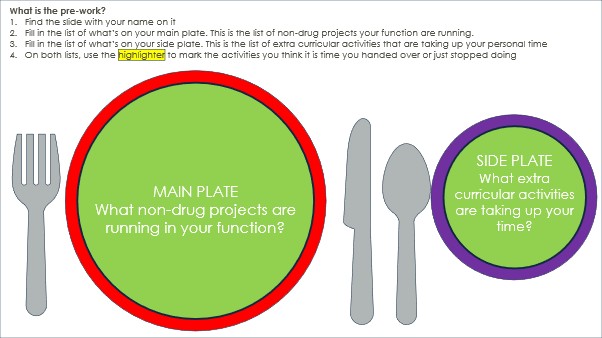
What’s on your plate?
One of the most powerful elements of this exercise is that it happens in the context of a team. Leaders share what’s on their plates, openly. They highlight what they’re ready to hand over or even stop entirely. And then something shifts.
Peers respond. They encourage. They suggest. They offer connections. For example, “I know someone who would grow from that.” In that moment, pruning stops being an individual act of letting go and becomes a collective act of growth.
It also brings clarity. By “contracting” with peers, leaders make visible decisions about what they will no longer carry, reducing the quiet creep of work returning unnoticed.
And perhaps most importantly, it reframes the act itself.
Pruning isn’t about doing less
It’s about being more intentional with where your energy goes.
Because leadership isn’t just about what you deliver. It’s about what you create space for in yourself, and in others.
So the question becomes not just:
“What’s on your plate?”
But
“What are you ready to let grow somewhere else?”