
Who leads inside you?
Which voice dominates pressure?
Are your inner archetypes aligned?
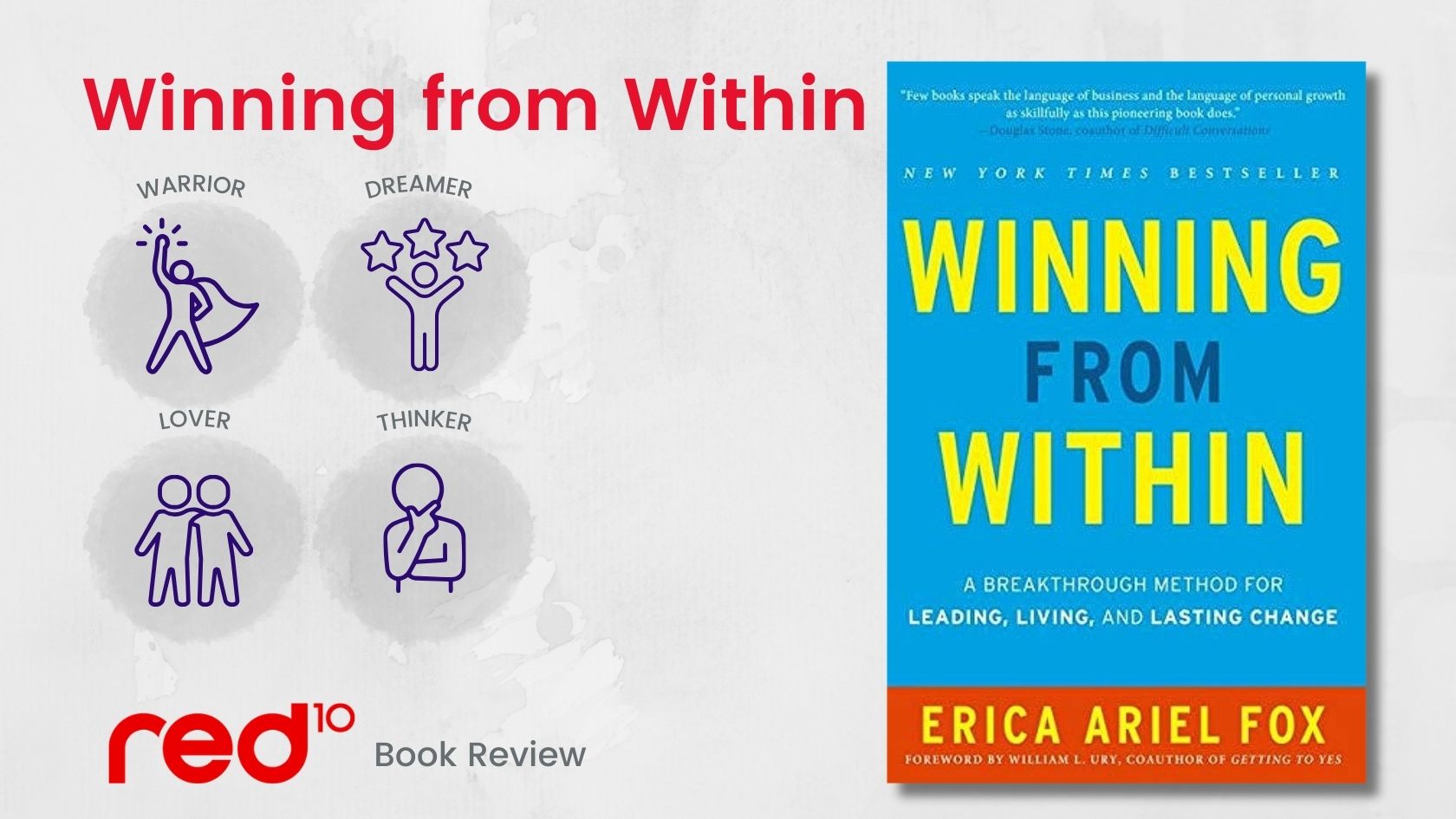
Here, red10 ‘s Will Sudworth explores the ideas in Winning from Within by Erica Fox, focusing on the four core archetypes at the heart of the book: the Warrior, Dreamer, Lover, and Thinker.
What’s the central message?
Erica Fox’s central message is that leadership effectiveness isn’t just about skills or strategy — it’s about how well we integrate these inner roles so they work together rather than compete. When leaders understand their inner dynamics, they gain the ability to respond deliberately rather than react habitually.
In the same way that Kathryn Myers and Isabella Briggs took Carl Jung‘s work on personality and created a lovely branded evidence-based package now known as Myers-Briggs, Erica Fox has taken Carl Jung’s work on archetypes and made it more accessible.
Why do archetypes shape leadership?
Fox suggests that every leader draws from four fundamental energies. These aren’t personality labels or fixed traits; they’re capacities available to all of us. The challenge is balance. Too much reliance on one archetype narrows perspective, while too little leaves a capability underdeveloped.
Leadership maturity, then, is less about adding new tools and more about expanding range — knowing which archetype the situation calls for and consciously stepping into it. This perspective reframes leadership development from learning what to do to understanding who to be in each moment.
What does the Warrior bring?

The Warrior is the part of us that acts. It sets direction, makes decisions, and holds boundaries. Without the Warrior, leadership drifts; with too much of it, leadership can become forceful or rigid.
At its best, the Warrior provides courage and clarity. It enables leaders to make tough calls, hold accountability, and move teams forward when ambiguity or resistance appears. Many organisations reward Warrior energy, but Fox reminds us that action without reflection can create unintended consequences. The key is purposeful action grounded in awareness.
How does the Dreamer expand possibility?
 The Dreamer imagines what could be. It brings vision, creativity, and the capacity to step back from immediate pressures to see the bigger picture.
When leaders neglect the Dreamer, organisations risk becoming operationally efficient but strategically stagnant. When they over-rely on it, ideas can outpace execution. The art is pairing the Dreamer’s imagination with the Warrior’s drive — vision anchored in action. In fast-moving environments, this balance ensures innovation doesn’t come at the expense of delivery.
Why is the Lover essential?
 The Lover represents connection.
It’s the part of us that builds trust, shows empathy, and senses the emotional climate of a room. In leadership, this translates to relationships that enable performance.
Without the Lover, teams may achieve results but at the cost of engagement or psychological safety. With too much of it, leaders can avoid difficult conversations.
Balanced well, the Lover ensures people feel seen while still moving toward shared goals. It is often the difference between compliance and commitment.
What role does the Thinker play?
 The Thinker brings analysis, objectivity, and perspective. It slows the pace just enough to ask: What’s really going on? This archetype helps leaders interpret complexity, challenge assumptions, and make sense of data.
Overused, the Thinker can lead to over-analysis or detachment; underused, decisions may lack rigour. Its power lies in helping leaders step back from emotion and instinct to make thoughtful, grounded choices.
In uncertain environments, the Thinker creates clarity where others see noise.
How do you integrate the four?
Fox’s core insight is that leadership strength comes not from favouring one archetype but from orchestrating all four. The most effective leaders can notice which voice is stepping forward and consciously invite the others in.
In practice, this might look like using the Dreamer to shape strategy, the Thinker to test it, the Lover to bring people with you, and the Warrior to execute. When leaders lead themselves well, they create the conditions for others to do the same.
Interested in diving deeper?
Only got 5-mins?
Listen to the Harvard Business Review IdeaCast episode exploring inner conflict and self-leadership:
Got 1 hour or prefer video?
Sounds True / Insights at the Edge full-length interview