

How do you move forward when fear shows up?
What if fear is part of growth, not proof of weakness?
Could choosing courage become a daily habit?
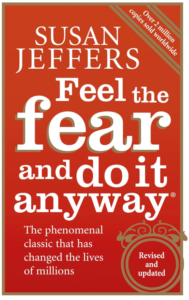
Here, red10 ‘s Will Sudworth, assisted by AI, explores Feel the Fear and Do It Anyway by Susan Jeffers—an enduring guide to navigating uncertainty, strengthening agency, and discovering the calm confidence that sits beneath all our anxieties.
What does fear really want from us?
Jeffers begins with a simple, disarming idea: fear is not a sign that something is wrong with us—fear is a sign that we are stretching. Growth and discomfort are twins.
Most of us unconsciously wait for the day when fear disappears before we take the next step, whether that step is speaking up in a meeting, shifting roles, or having a difficult conversation. Jeffers flips that expectation. Fear is not a barrier to action; fear is the price of admission for a bigger life. The question is not “How do I remove fear?” but rather “How do I move with it?”
She argues that the root of most fear is a loss of control. When we feel powerless, we panic. When we feel capable, fear shrinks. This is why leadership development often centres on building choice, agency, and confidence. Jeffers’ work aligns beautifully with red10 ‘s focus on self-awareness and personal responsibility: leaders grow by learning where they can act, not where they can’t.
How do we shift from powerlessness to personal power?
Jeffers’ most famous idea is the “Pain-to-Power” chart—a shift from reactive thinking (“I can’t…”, “What if it goes wrong?”) to proactive thinking (“I’ll handle it”, “I can choose my response”). This shift is not motivational fluff. It is a trained mental discipline.
She outlines three levels of fear:
- Surface fears – things like public speaking, conflict, job changes.
- Deeper fears – rejection, failure, judgement.
- The deepest fear – “I won’t be able to handle it.”
That final layer is what everything else sits on. And it is also where the breakthrough lives.
Jeffers teaches leaders to replace “I’m not ready” with “I can handle whatever comes.”
It’s grounded, practical optimism—not a denial of risk, but a belief in capability.
This mirrors red10 ‘s approach when we help leaders differentiate between danger (which is real and needs mitigating) and discomfort (which is safe and necessary for growth). Jeffers gives language and tools that help leaders act even in moments of emotional turbulence.
What daily practices help us become braver?
Jeffers is clear: courage is not built in big moments—it is built through consistent micro-actions.
She offers several tools leaders can use straight away:
- 1The “No-Lose Decision-Making” model
Instead of agonising over “right vs wrong”, Jeffers invites us to look for “growth vs growth”. Each path, if approached with curiosity, offers learning. This reduces paralysis and speeds up psychological momentum.
- 2
Positive self-talk that isn’t cheesy
Her recommended phrase—“I can handle it”—is deceptively powerful. It reframes uncertainty as capability, echoing cognitive-behavioural techniques and red10 ‘s work on mindset.
- 3
Leaning into discomfort, intentionally
Jeffers encourages leaders to practise small acts of bravery: asking a question, making a request, sharing an idea. By choosing discomfort regularly, fear slowly loses its grip.
- 4
Expanding the comfort zone through action, not thought
Confidence doesn’t precede action; confidence follows action. Jeffers’ key contribution is giving leaders a framework to test this safely and consistently.
How can leaders use Jeffers’ ideas with their teams?
Fear is contagious—but so is courage.
Teams often avoid conflict, delay decisions, or silence disagreement because fear is present and unspoken. A leader equipped with Jeffers’ ideas can normalise fear without pathologising it.
Useful prompts include:
- “What part of this feels uncomfortable—and what might that be signalling?”
- “What’s the smallest action we can take to get momentum?”
- “How can we support each other to step into uncertainty?”
Jeffers also emphasises generosity. Fear makes us contract; courage makes us expand. This links with red10’s work on psychological safety: when fear is acknowledged rather than hidden, teams move faster, speak more honestly, and act more boldly.
Why does this book still matter?
Published in 1987, the book remains a staple for one reason: fear is timeless. Leadership now involves complexity, pace, ambiguity, hybrid working, and constant visibility. The inner landscape of leaders matters more than ever.
Jeffers gives leaders a way to work with their inner critic—not fight it, not ignore it, but walk alongside it. Her central message stands strong:
We don’t wait for fear to disappear.
We move forward—and fear shrinks in our wake.
Interested in diving deeper?
Only got 5-mins?
Listen to the Harvard Business Review IdeaCast episode exploring inner conflict and self-leadership:
Got 1 hour or prefer video?
Sounds True / Insights at the Edge full-length interview
Read or listen to the full book
UK Amazon: https://www.amazon.co.uk/Feel-Fear-Do-Anyway/dp/1785042652
US Amazon: https://www.amazon.com/Feel-Fear-Do-Anyway/dp/0345487427