
What challenge is really in front of you?
How do you grow the capacity of your system?
What might change if you paused, noticed, and chose differently?
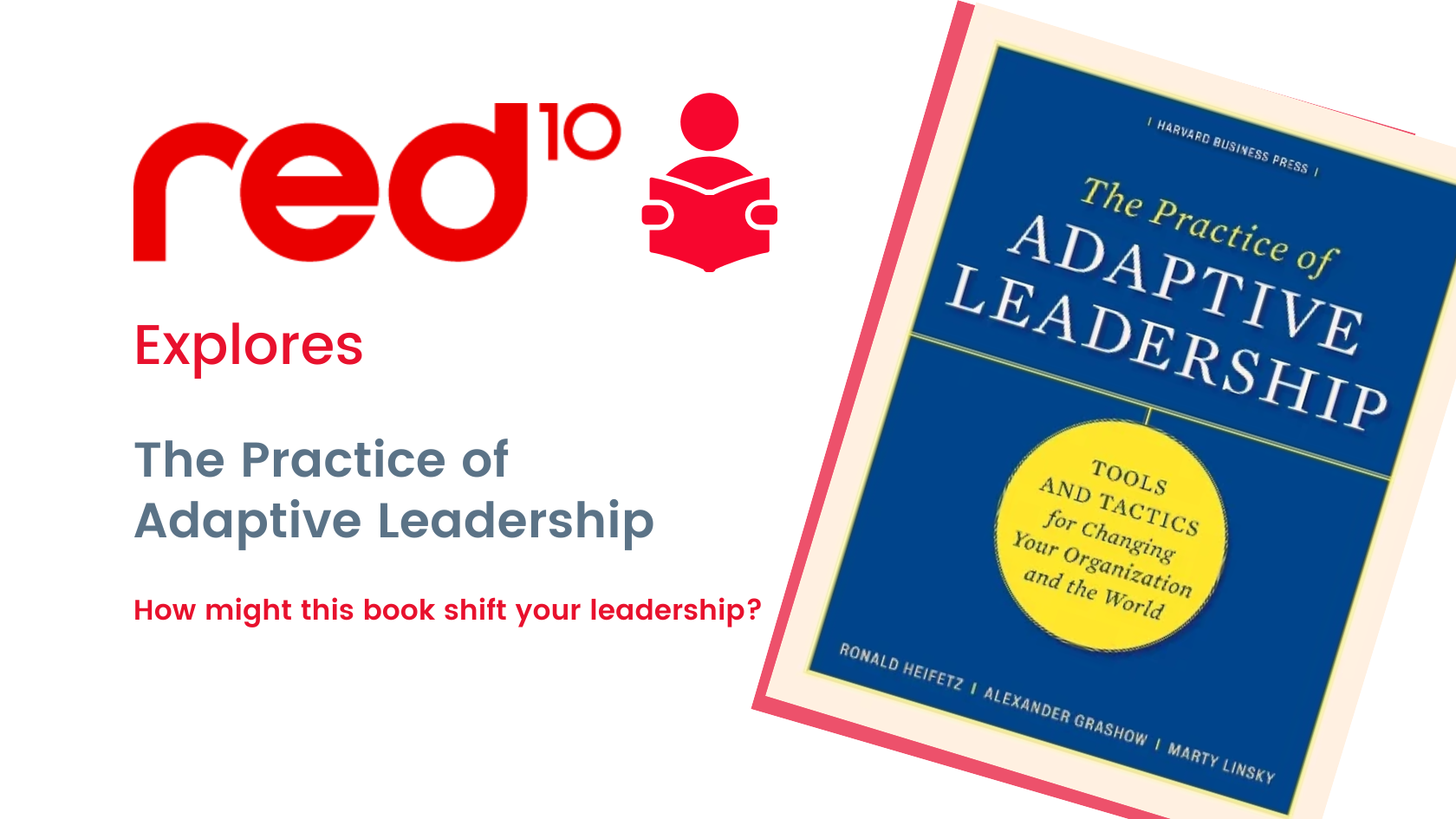
Here, red10 ‘s Will Sudworth – with AI-assistance – explores The Practice of Adaptive Leadership by Heifetz, Grashow and Linsky, a field-defining guide for leaders navigating complexity, emotion and change.
What makes adaptive leadership different?
The authors draw a clear distinction that reshapes how leaders interpret the problems they face. Technical challenges can be solved with existing expertise, tools and procedures. Adaptive challenges, however, require changes in people’s priorities, behaviours, roles and beliefs. The organisation must grow — not simply execute.
This single shift in perspective is powerful. It reframes leadership from the heroic delivery of solutions to the collective work of learning. Instead of being the person with the answer, the adaptive leader becomes the person who creates the conditions for people to surface assumptions, experiment and grow.
Heifetz and colleagues invite leaders to step away from the “fix-it” reflex and instead diagnose what type of challenge the team is truly facing. Doing this well lays the groundwork for everything else in the book.
How can leaders see more clearly?
The authors introduce the now-famous discipline of “getting on the balcony.” It’s a vivid metaphor: imagine rising above the dance floor to observe patterns, alliances, resistance, pace and energy. Leaders who stay on the dancefloor — embedded in the action — often miss the dynamics that are shaping the system.
Balcony work includes:
- spotting loyalties and losses driving behaviour
- noticing who is over- or under-functioning
- identifying unspoken stories or fears
- observing whether the heat of the system is too high or too low
This reflective distance enables better judgement and helps leaders resist the gravitational pull of urgency, firefighting and over-responsibility. The book emphasises that seeing the system is not a one-off step; it is an ongoing practice requiring discipline and courage.
How do leaders regulate the heat?
Adaptive work is emotionally demanding. When change touches identity — “who we are” or “what we value” — people experience threat, loss, uncertainty and sometimes grief. The authors offer a practical metaphor: the temperature gauge.
- Too cold: people stay comfortable; no change occurs.
- Too hot: anxiety overwhelms; people shut down or attack.
- Just right: enough tension for learning, not so much that people burn out.
Adaptive leaders therefore regulate heat — raising it through questions, experiments and expectations, or lowering it through pacing, support and clarity. This skill helps teams remain in what the authors call the productive zone of disequilibrium.
The message is clear: leadership is not about protecting people from discomfort, but rather containing and guiding that discomfort so that it becomes productive.
What role does tough conversation play?
The authors highlight that progress depends on naming what is really going on. That often requires courageous conversations about values, trade-offs, authority, and what people are willing to let go of.
Adaptive challenges nearly always involve loss, and loss triggers resistance. Leaders are encouraged to surface:
- what stakeholders fear losing
- which loyalties are in tension
- what sacred cows are limiting progress
- which norms need to be renegotiated
These discussions can feel uncomfortable, yet they create clarity, alignment and possibility. Without them, teams risk cycling endlessly around unspoken issues.
How can leaders sustain themselves during uncertainty?
The book closes with a deeply human reminder: adaptive leadership is not just cognitively difficult — it is emotionally taxing. Leaders face criticism, isolation, role pressure, and the temptation to retreat into the comfort of technical solutions.
The authors encourage practices that build resilience:
- connecting to purpose
- developing confidants and allies
- regulating one’s own heat
- maintaining perspective
- pacing oneself for the long haul
Their message: to lead adaptively, you need to stay alive — physically, emotionally and relationally. Sustainable leadership depends on habits that renew rather than drain.
How might this book shift your leadership?
The Practice of Adaptive Leadership reframes leadership as the art of working with what is emerging — not controlling it. It encourages leaders to see more, stay curious, experiment, and help others thrive in uncertainty. For teams, it provides a practical shared language: technical vs. adaptive; balcony vs. dancefloor; heat and holding environments; loss and loyalty; purpose and resilience.
It is a book that gives leaders not just tools, yet a way of understanding the world differently.
Interested in diving deeper?
Only got 5-mins?
Listen to the Harvard Business Review IdeaCast episode exploring inner conflict and self-leadership:
Got 1 hour or prefer video?
Sounds True / Insights at the Edge full-length interview
Read or listen to the book:
UK Amazon: https://www.amazon.co.uk/dp/B09KX499BS
USA Amazon: https://www.amazon.com/dp/B09KX499BS